If you are exploring how real-time handwriting recognition can integrate with your intelligent tutoring system or AI assessment product, the MyScript team would be glad to talk through what is technically possible for your use case.
Contact us6/10/2026
Why EdTech Builders Should Rethink AI Tutoring Around Digital Ink
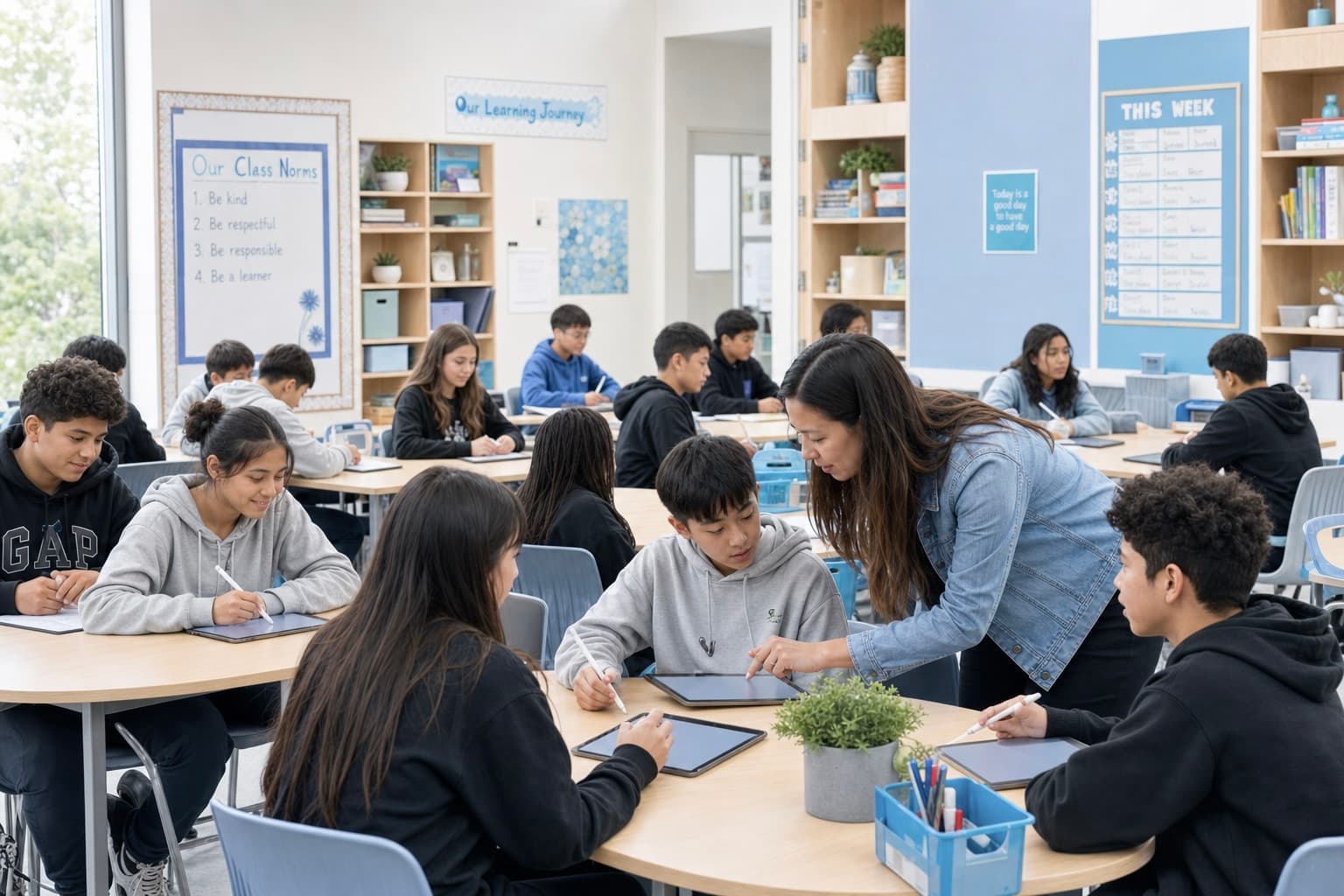
The intelligent tutoring system market is projected to grow from $3.7 billion in 2025 to $44.2 billion by 2034.1 Every major EdTech player is building an AI tutor or assessment layer, and most are building on the same narrow signal: a student types a question, the system returns an answer, a hint, or a score. It is the chatbot model applied to education. That is not tutoring. It is retrieval on demand.
This article makes a specific argument: the richest signal in learning is not what students type but what they write by hand. Handwritten work captures reasoning as it forms, and real-time handwriting recognition makes that signal usable by a tutoring or assessment product today.
The Problem Is Not the Model. It Is What the Model Can See.
When a tutoring system relies on typed input, it receives the cleaned-up version of student thinking. By the time a learner submits an answer, the most revealing part of the process is gone: the hesitation before committing to a solution, the crossed-out step that revealed a misconception, the diagram showing a concept understood spatially but not yet verbally, the abandoned approach replaced by a second attempt. None of that survives the translation into a text box.
The U.S. Department of Education identifies formative assessment, real-time insight into student understanding during the learning process, as one of the highest-potential areas for responsible AI use in education.2 But genuine formative assessment requires seeing thinking in progress, not just evaluating conclusions. Research points the same way: a systematic review of AI-driven tutoring systems in K-12 found that the alignment between what a system observes and what it tries to improve is a critical variable in real-world impact.3 A system that only sees final answers cannot do formative assessment. Not because the model is too weak, but because the input is too late.
The Signal Teachers Use, and Cannot Scale
A teacher skilled at formative assessment does not just check final answers. They watch: the unusual pause, the pencil hesitating over a step, work that shows mastery of one operation and confusion about the next. They intervene before a misconception takes hold and propagates into the next five problems. That kind of observation depends on proximity and time, and schools have neither at scale. Over 25 states mandate tutoring programs and 80% of districts expanded tutoring after COVID, yet schools report that staffing prevents delivering it at the intensity research requires: sessions three to five times per week at ratios no higher than 1:3 or 1:4.4 5 A teacher with 25 to 30 students cannot respond to each learner at the moment confusion appears.
This is precisely where intelligent tutoring should close the gap: not by replacing the teacher, but by handling the first response when the teacher is occupied. Current products attempt this with adaptive content, hint sequences, and feedback on submitted answers. Useful, but reactive to what a student submits rather than responsive to how a student is working. There is a meaningful difference between a system that waits for a student to ask for help and one that detects the moment a student needs it.
Handwriting Is the Missing Signal Layer
In most learning contexts that involve reasoning (math problem-solving, scientific notation, open-response writing, annotation), students think with a pen. Research consistently shows that handwriting engages broader networks of brain activity than typing and supports deeper encoding.6 Students who handwrite intermediate steps or sketch a diagram are externalizing their reasoning in a form that is observable, sequential, and informationally dense.
Learn more in our post Why Writing by Hand Leads to Better Learning.
That is particularly true in math and mixed text-math contexts, where the signal is densest. Historically it has been hard to capture: most handwriting recognition systems collapse when students move between natural language and mathematical notation in the same workflow. This is exactly the problem MyScript's recognition technology solves: handwritten math and text interpreted fluently in the same flow, in real time, without mode switching or special syntax. Yet most EdTech products still default to equation builders or LaTeX input, which interrupt reasoning at exactly the moment a student needs to focus on the problem.
We explore this in more detail in The Hidden Cost of Bad Math Input in EdTech.
For a tutoring system, real-time recognition opens a door no typed interface can: student reasoning as it forms, as a live stream of ink strokes rather than a static scan. The system can detect the wrong turn before the student reaches the wrong answer, see the moment a learner abandons one approach for another, and recognize the student who applies the right method but slips on the final arithmetic, responding to that specific situation instead of triggering a generic hint. The same understanding can be surfaced to the teacher as a live view of which students are confident, which are stuck, and which need a targeted intervention. Instead of circulating the room hoping to notice the right student at the right moment, the teacher has a signal.
From Grading Tool to Instructional Asset
AI essay grading illustrates the same shift. Most tools operate on completed text: the student writes, submits, the system scores. That saves grading time, but it remains summative. It says nothing about where reasoning broke down mid-draft or what a well-timed intervention could have changed. In supervised classroom settings, exactly the environments schools are creating in response to AI-generated homework concerns,7 students writing by hand produce a continuous, time-stamped record of their thinking. A system reading that record can flag a structural problem at the outline stage rather than after 500 words built on a shaky premise, and show a teacher where the whole class is struggling instead of delivering 28 essays at the end of the period with the same misunderstanding in all of them.
Where Differentiation Comes From
Most AI tutoring products are converging on the same architecture: large language models connected to content libraries, accessed through typed interfaces. That position is hard to differentiate, because improving models keep compressing the quality gap between competitors. When the model becomes a commodity, the signal layer becomes the product.
Handwriting-aware tutoring competes on a different axis: processing digital ink in real time, interpreting it as structured learning content, and connecting it to tutoring logic or teacher dashboards. Building that recognition capability independently is a substantial engineering investment, but it does not have to be built: MyScript provides it as a developer API covering mathematical notation, free-form prose, annotation, and multilingual content. And because EdTech procurement cycles are long and deeply embedded products earn long retention, an advantage built on a signal typed interfaces cannot replicate stays durable across generations of model improvements.
The question worth sitting with, if you are building a tutoring or AI assessment product: are you working with the full signal of what your students are thinking, or only the version that survived the text box?
Footnotes
- Dimension Market Research. Intelligent Tutoring Systems Market Size, CAGR, Trends. ↩
- U.S. Department of Education, Office of Educational Technology. Artificial Intelligence and the Future of Teaching and Learning. ↩
- Nature npj Science of Learning. A systematic review of AI-driven intelligent tutoring systems (ITS) in K-12. ↩
- American Progress. Fact Sheet: Scaling Up High-Dosage Tutoring Is Crucial to Students’ Success. ↩
- Education Trust. State Guidance for High Impact Tutoring. ↩
- Scientific American. Why Writing by Hand Is Better for Memory and Learning. ↩
- Education Week. Teachers Turn to Pen and Paper Amid AI Cheating Fears, Survey Finds. ↩