As schools rethink screen time, the opportunity is not less technology in every case. It is better technology, tools that support handwriting, attention, and real learning. If your team is exploring digital handwriting, we can help.
Contact our team5/6/2026
Digital Handwriting in School: A Smarter Answer to Screen Time
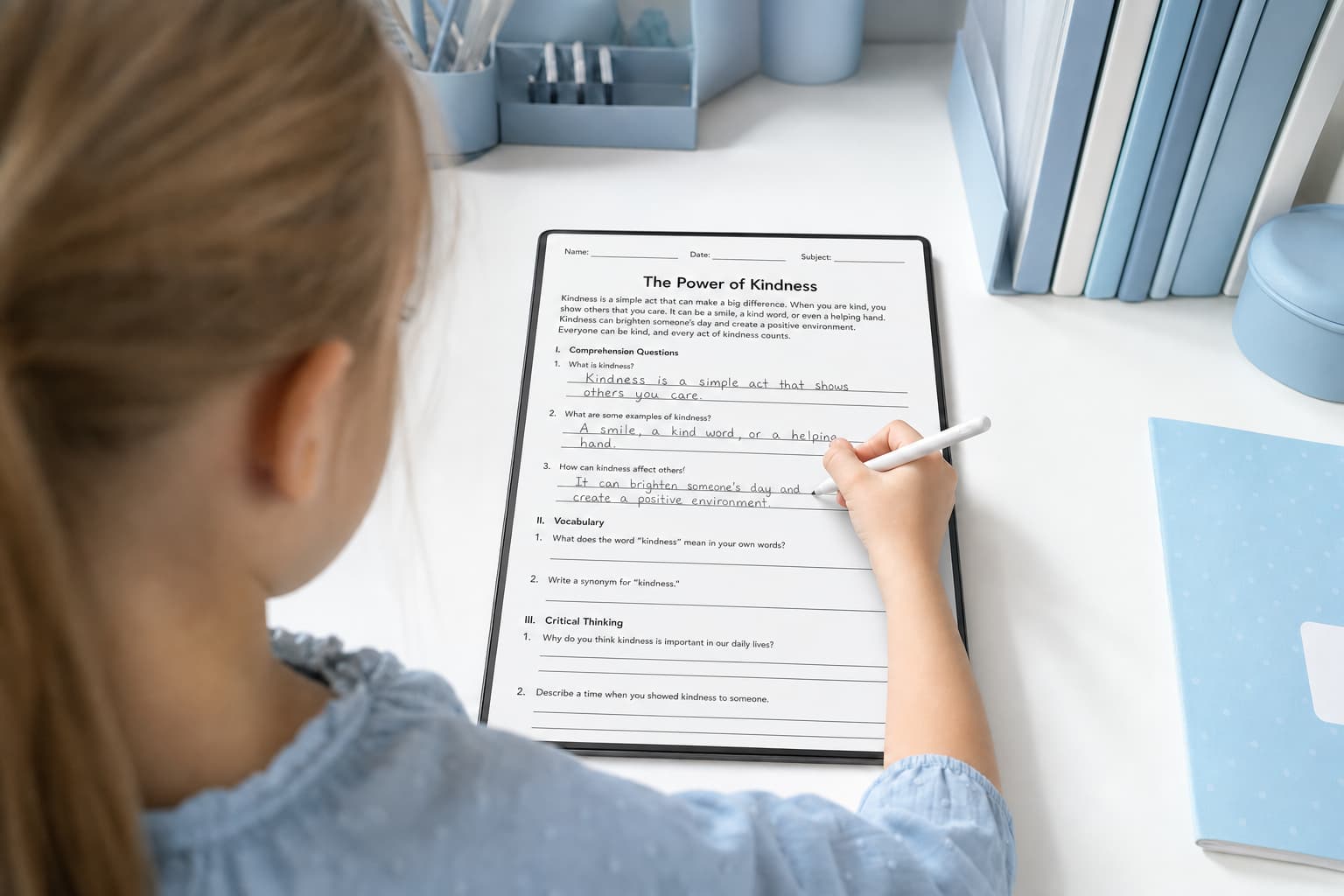
Recent debates in the United States show that school screen time has become a more contested issue among educators, parents, pediatricians, and policymakers.1 In several districts and states, leaders are revisiting earlier assumptions that more devices automatically lead to better learning, especially for younger students.2 That shift does not have to be read as anti-technology. It can also be understood as a signal that schools want technology to align more closely with attention, development, and instructional purpose.
For companies building education technology, that change in mood carries an important lesson. The opportunity is not to defend every existing screen-based workflow, but to design tools that respond to the concerns now shaping the conversation around classroom technology. One of the clearest gaps is handwriting.
A large share of EdTech still assumes that student work will arrive through typing, tapping, selecting, or speaking. Yet much school learning still begins with listening to the teacher, participating in discussion, and producing handwritten notes, rough drafts, annotations, labels, shapes, and worked solutions. When digital tools fail to capture or support those forms of thinking, they risk overlooking part of the learning process rather than improving it.3
Why Digital Handwriting Fits the Debate
This is why digital handwriting matters. If concerns about screen time are really concerns about passive use, distraction, fragmented attention, or low-value digital tasks, then the answer is not necessarily fewer digital tools in every case. A stronger answer is technology that preserves the cognitive and expressive value of writing by hand while adding the strengths of digital systems.
A student writing with a stylus can still draft ideas, solve equations, sketch diagrams, annotate text, or show intermediate thinking. At the same time, the system can offer features that paper cannot easily provide at scale: searchable storage, teacher visibility, revision history, accessibility supports, and timely feedback. For some students and subjects, especially where process matters as much as the final answer, those features can be genuinely useful.4
That does not mean every digital workflow is automatically better. Schools are increasingly asking whether technology supports a real learning goal, whether it encourages active rather than passive use, and whether it adds educational value rather than simply more exposure to screens.
A balanced interpretation follows from that evidence. Handwriting still appears to matter for literacy, memory, and conceptual learning in at least some contexts, while digital tools can add value when they improve accessibility, feedback, revision, or instructional insight.5 The practical question is therefore not whether schools should choose paper over technology forever. It is whether technology can support handwriting as a native and valuable form of student thinking.
What EdTech Should Build Next
For EdTech companies, treating handwriting as a first-class feature should mean more than adding a stylus input box. It should mean recognizing handwritten responses, preserving original student work, supporting mathematical notation and diagramming, helping teachers review process as well as outcomes, and delivering feedback without forcing every learner into keyboard-first workflows. It should also mean designing products that fit blended classrooms, where paper-based and digital learning reinforce each other rather than compete for time.
That framing can help the industry answer current concerns about school screen time without taking an anti-school or anti-technology stance. Schools and educators are already raising harder questions about how devices are used and when they help, and the strongest response from EdTech is better design: tools that respect handwriting, reduce low-value screen exposure, and make technology more closely match the way students actually learn.6
Footnotes
- American Academy of Pediatrics. Digital Ecosystems, Children, and Adolescents: Policy Statement. ↩
- MultiState. Elementary School Screen Time Limits Gain Momentum in 2026. ↩
- Edutopia. Podcast: Handwriting Is Essential—Here's How to Teach It. ↩
- Mark My Words. AI Handwriting Recognition for Teachers. ↩
- ScienceDirect. Writing by hand or digitally in first grade: Effects on rate of learning to write. ↩
- Education Week. How to Lessen Screen Time in Schools—and Make It More Effective. ↩